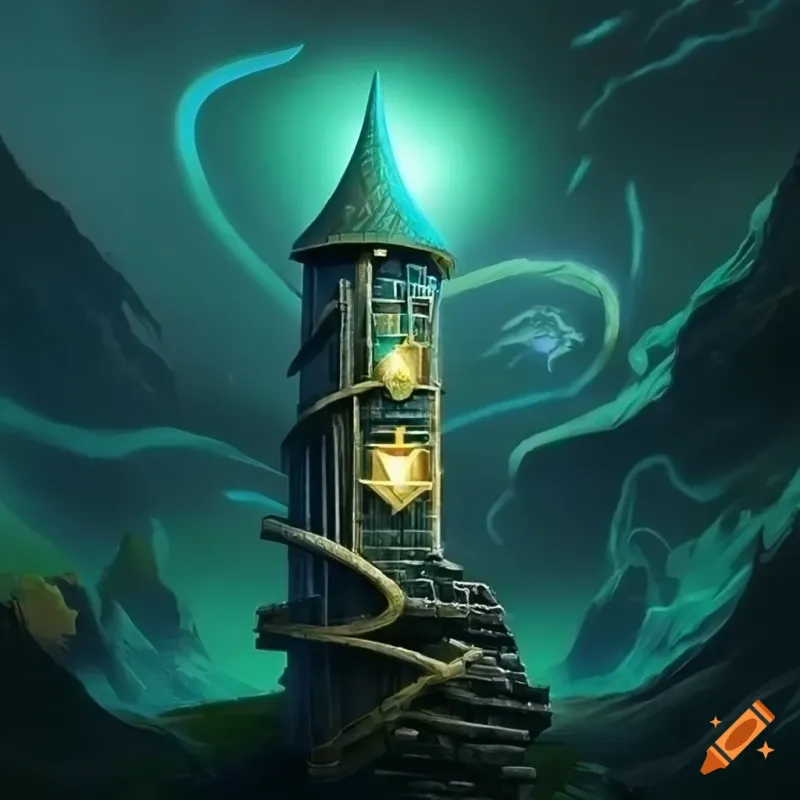
Blueprints for the Impossible Break-In: A Wizard's Tower Heist That Scales to Any Tier
Photo: Internet Archive Book Images, No restrictions, via Wikimedia Commons
The wizard's tower is the closest thing fantasy gaming has to a perfect adventure container. It is a location, a villain, a puzzle box, and a loot piñata that seals itself behind you. You can run one tonight with two hours of prep, and you can run the exact same structure five levels later with the wizard's older brother living upstairs.
What follows is a chassis, not a module — the fixed parts that make a heist work, plus the dials you turn to move it up and down the level curve.
Why the Tower Works
Three properties do the heavy lifting. First, it is self-contained: one map, one antagonist, one exit, no sprawling city districts to improvise. Second, its owner is by definition paranoid and rich, which means every security measure you invent is in character. Third — and this matters more than people admit — the tower's contents are portable. Wands, scrolls, components, tomes, a bottled thing that should not be bottled. Heist objectives that fit in a bag are easier to make urgent than objectives that don't.
The Five Beats
Every heist, at every tier, is these five scenes in this order. Change the trappings; keep the spine.
- The recon. The party learns the tower's layout, its owner's habits, and one true thing that nobody else knows.
- The approach. Getting to the door is its own problem — a moat of ground, a cliff, a street with too many eyes.
- The breach. Crossing the threshold triggers the real adventure. Something always goes sideways here.
- The score. Finding and taking the object, which is never where the map says it is.
- The getaway. The tower reacts, and the party has to leave under pressure with something heavier than they arrived with.
That last beat is where most homebrew heists fall apart, and we will come back to it.
Scaling the Tower
| Tier | Owner | Security | Guardians | The Score |
|---|---|---|---|---|
| 1–4 | A hedge-wizard with one real spell | A locked door, an alarm bell, a suspicious apprentice | Two trained dogs and a bad attitude | A stolen spellbook page, a potion, one honest treasure |
| 5–10 | A guild enchanter with debts | Glyph wards, a contract-bound servant, a false floor | Animated armor, a summoned scout, rented mercenaries | A wand the guild wants back, a ledger of clients |
| 11–16 | An archmage in exile | Planar anchor, password-locked rooms, a room that is not in the same building as the rest | A bound fiend with conditions, a pair of rival apprentices | A sealed reagent, a name the archmage stole |
| 17–20 | Something that was a wizard once | The tower is awake; rooms rearrange by intent; scrying is punished | A demiplane's worth of retainers, one genuinely loyal ally | A memory, a dead god's fingernail, the entrance to somewhere else |
Room-by-Room Prompts
You need five to seven rooms. Not twelve. Every room should have one thing to notice, one thing to take, and one thing that can go wrong.
The Latch. The first door. Ask the players what it is made of and then use their answer. The latch should be solvable but should also cost something — noise, time, or a favor.
The Stair That Argues. Vertical space is the tower's signature. Make the stairs a hazard, a puzzle, or a social encounter instead of a corridor. Bonus points if the stair goes somewhere on the way up that it does not go on the way down.
The Working Room. Where the owner actually does magic. Smells like something. Contains partially finished business — a half-written letter, a cooling crucible, a thing in a jar that knows the party's names. This room is where a heist becomes a story, because it is where the party learns the owner is a person.
The Collection. Trophies behind glass. Everything here is worth money and half of it is alarmed, cursed, or both. Give the greediest player a genuinely hard choice and no time to make it.
The Vault. Not a metal box. A condition. The vault opens for the owner's voice, or for someone who has genuinely wronged them, or only while music plays. The party's recon should reveal the method; their creativity should reveal a loophole.
The Roof. Always give the tower a roof. Every good heist needs a place to look down from, and every good tower wants you to be up there when everything goes wrong.
Security That Isn't Just Glyphs
The temptation is to line every hallway with traps. Resist it. Varied security produces varied play. Mix:
- Loud things. Alarms, bells, a familiar that screams. The party can handle a threat; handling a clock is harder.
- Bound things. Servants and guardians with contracts. These can be negotiated with, bribed, or freed — and freeing them has consequences later.
- Bureaucratic things. Wards that require a name, a contract, a signed permission. Social obstacles inside a physical space.
- The tower itself. At high tiers, the building has opinions. Rooms move toward what the intruder wants. Corridors loop. The tower is trying to help, in the worst possible way.
Rival Crews
Every heist is better with competition. Introduce one rival crew during recon — three or four competent people with a different plan and the same objective. Do not script their success or failure. Give them a goal, a timeline, and a willingness to improvise, then let them occupy the same tower as the party. They can be obstacles, unexpected allies, or the reason the getaway goes wrong. If the players form a temporary alliance with them, you have just built the next three sessions.
Failure Forward
Heists go wrong. Design for it. Every failed check produces a new problem, never a dead end:
- The lock opens, and the alarm opens with it.
- The party gets in, but their rope is cut.
- They reach the vault, and the object is already gone — taken by the rival crew, moved by the owner, or missing in a way that is itself a clue.
- They get the object, and it is heavier than promised, literally or morally.
- Someone gets caught, and the owner would rather negotiate than fight.
Write two of these per room before the session. You will use exactly one and invent four more at the table, which is the correct ratio.
The Getaway
This is the beat that deserves the most prep and usually gets the least. The tower should react to the theft, not to the intruders — the party did not fail, they succeeded, and that is why everything is now on fire.
The getaway needs three elements: a closing window, an obstacle that can be cleared in more than one way, and a place that is safe only if they earned it earlier. That last one is the payoff for recon and for every favor they curried on the way up. If the party spent the first half of the session befriending the stablehand, the stablehand is now holding the gate.
Threading It Into a Campaign
A heist is best as a side quest with teeth, not a detour. Three hooks keep it attached:
- The object matters to the main plot. The party steals something they need, and stealing it makes an enemy of someone who could have been an ally.
- The owner is a faction. The archmage upstairs has connections that outlive the burglary. What they do about it is your next arc.
- The party owes somebody. Someone hired them. That someone is not telling them the whole truth about the vault, and the party will find out roughly forty minutes into the escape.
Run it once at low tier as a training exercise, then run the structure again years later against a much worse owner. Nothing teaches a table the cost of their own reputation like walking back into a tower that remembers them.